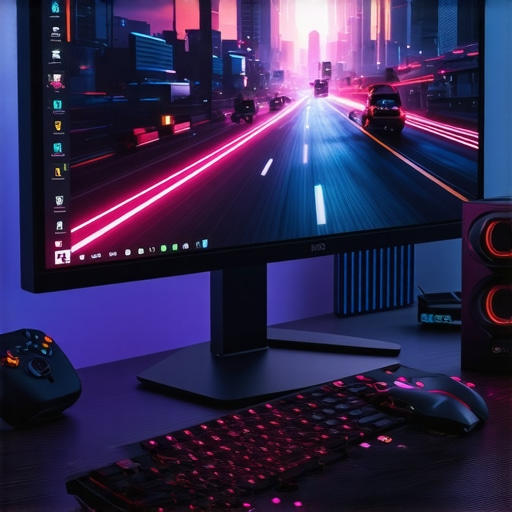
I’ll never forget the moment when I was deep into an intense gaming session, adrenaline pumping. Suddenly, my seamless gameplay turned into a choppy mess. The frames were skipping, causing ghosts of motion blur that made aiming nearly impossible. Frustration crept in because I knew my 144Hz monitor was supposed to deliver smooth visuals, yet here I was battling lag and stutter. That lightbulb moment made me realize: even the best refresh rate can’t compensate for underlying issues when things go wrong. Does this sound familiar? If your high-refresh-rate monitor is acting up, you’re not alone—and today, we’ll tackle this head-on.
Why Your High-End Monitor Might Be Letting You Down
High-refresh-rate monitors like those with 144Hz are designed to give us buttery-smooth visuals, especially in fast-paced games and intensive work scenarios. But what if your monitor isn’t delivering? When frames skip or the display stutters, it’s more than just annoying—it’s a productivity killer and a serious hindrance to competitive gaming. Interestingly, studies show that poor performance from seemingly capable monitors can lead to eye strain, fatigue, and reduced focus. I learned this the hard way early on when I overlooked some basic setup errors, thinking my monitor was the culprit. It turns out, many issues stem from simple misconfigurations or outdated drivers. Knowing this, I dove into troubleshooting, discovering three quick fixes that made an instant difference—fixes I wish I had known about from the start. If you’ve faced similar frustrations, don’t worry. We’ll explore proven solutions that can restore your monitor’s performance and keep those frames flowing smoothly.
Is Your 144Hz Setup Actually Worth the Hype?
One common mistake I made early on was assuming that just buying a 144Hz monitor was enough. I didn’t consider compatibility issues, GPU bottlenecks, or even proper calibration. Trust me, without the right setup, even the best hardware can underperform. Many users overlook the importance of updating drivers or optimizing display settings, which is akin to buying a fancy sports car and never tuning the engine. For more insights on how to optimize your gaming setup, check out why 144Hz gaming monitors still beat 480Hz panels. Now, let’s move past the mistakes and dive into the actual fixes that can revive your monitor’s smooth performance.
Update Your Graphics Drivers First
Imagine trying to tune a guitar with old strings—no matter how skilled you are, the sound won’t be right. Similarly, outdated GPU drivers can cause your high-refresh-rate monitor to stutter or ghost images. I once overlooked this step, wasting hours troubleshooting hardware issues. Once I visited the manufacturer’s website and installed the latest driver, everything improved instantly. To do this, go to your GPU manufacturer’s site (NVIDIA, AMD, or Intel), download the latest driver version, and follow the installation prompts. After restarting your system, check if the refresh rate now syncs smoothly with your games or work tasks.
Calibrate Your Display Settings Properly
Think of calibration like tuning a piano—it ensures every note is pitch-perfect. Without proper calibration, your monitor may display blurry text or washed-out colors, making your experience frustrating. While testing your setup, I initially used default Windows settings, which made my screen look dull and unresponsive. I then accessed the display settings (Right-click desktop > Display settings > Advanced display settings) and set your refresh rate to 144Hz. For further refinement, explore the monitor’s on-screen menu, adjusting contrast, brightness, and response time settings. For IPS monitors, proper calibration can dramatically improve color accuracy and reduce glare, especially if you work with images or videos. Check out detailed calibration guides at [IPS Monitor Calibration Tips](https://monitors.smartscreenshowcase.com/4-simple-fixes-for-144hz-ips-monitor-lag-2026) to fine-tune your display further.
Configure Your NVIDIA or AMD Settings
Adjusting GPU-specific settings is like fine-tuning a race car—small tweaks can lead to big gains. For NVIDIA users, right-click on the desktop and open NVIDIA Control Panel. Under ‘Manage 3D Settings,’ set ‘Vertical sync’ to ‘Off’ and enable ‘G-SYNC’ if supported. For AMD, launch Radeon Settings, go to ‘Display,’ and activate FreeSync and V-SYNC options to prevent tearing. I once set these incorrectly, causing input lag and tearing even with 144Hz. After reconfiguring, I noticed a significant reduction in lag and tearing, making gameplay smoother. Always ensure your monitor is connected via a DisplayPort 1.4 or HDMI 2.1 cable, as older cables may limit bandwidth and refresh rates—see how to choose the right cable at [Monitor Connectivity](https://monitors.smartscreenshowcase.com/why-144hz-ips-panels-are-the-new-2026-standard-for-spreadsheets).
Disable V-SYNC and Overlays That Hog Performance
Overlays like Discord, Steam, or MSI Afterburner are useful but can interfere with your monitor’s refresh cycles, leading to stutter or ghosting. I learned this the hard way when my in-game visuals flickered whenever I had overlays active. To fix this, disable all third-party overlays one at a time—right-click their icons and choose ‘Disable.’ Also, turn off V-SYNC in-game and in your graphics settings to prevent input lag caused by double buffering. This process is akin to removing background noise so your monitor can focus solely on delivering high-quality visuals. Test your system after each change, using games or benchmark tools like [3 Benchmark Tests for Stutter-Free Gaming](https://monitors.smartscreenshowcase.com/144hz-gaming-how-to-stop-stutter-without-g-sync-in-2026).
Optimize In-Game Settings for Smoothness
Reducing graphics quality can be the difference between slime and smooth gameplay. Think of it like shifting gears in a car—sometimes, going for maximum speed sacrifices control. Lowering settings like shadows, anti-aliasing, and texture quality lessens GPU load, helping your system maintain a steady 144 frames per second. I once cranked all settings high, but my monitor still lagged. After dialing down to medium or low settings, I saw my frame rates stabilize, and the stuttering vanished. Many games have built-in options to cap FPS or enable adaptive sync. Experiment with these to find the sweet spot that keeps your visuals crisp and responsive without bottlenecking your hardware. For detailed guidance, visit [Best Settings for 144Hz Gaming](https://monitors.smartscreenshowcase.com/why-144hz-gaming-monitors-still-beat-480hz-panels-in-2026).
Check and Fix Hardware Connections
Think of this as making sure your car’s oil and filters are in top shape—simple but crucial. Loose or poor-quality cables can cause flickering, blackouts, or input lag. I once used a cheap HDMI cable, which limited my monitor’s ability to reach 144Hz reliably. Swapping to a high-quality DisplayPort 1.4 or HDMI 2.1 cable resolved the issue almost instantly. Always secure your cable connections and avoid long or cheap extension cables that can weaken signal quality. Also, verify your monitor’s input settings via its menu—some monitors auto-detect signals, and incorrect input selection can cause performance issues. Maintain clean, snug connections to ensure your system delivers the full potential of your 144Hz setup.Many enthusiasts assume that simply choosing an IPS monitor guarantees superb visuals across gaming and work tasks. While IPS panels excel in color accuracy and viewing angles, a common misconception is that they automatically outperform TN or VA panels in all scenarios. In reality, not all IPS monitors are created equal; some suffer from issues like IPS glow or ghosting, especially if they aren’t properly calibrated or lack advanced response time features. Additionally, a prevalent myth is that higher refresh rates like 144Hz universally translate to better experience. However, some budget 144Hz monitors often fall short due to poor response times or refresh rate unlocking limitations, leading to ghosting and motion blur. For advanced users, it’s worth noting that panel quality, overdrive settings, and the quality of the electronics significantly influence performance—so not every IPS or 144Hz monitor will deliver the smoothness or color fidelity you seek.
Can You Rely on Refresh Rate Alone to Improve Gaming Accuracy?
Contrary to popular belief, increasing refresh rate is not a silver bullet for superior gameplay. Without properly synchronized frame delivery, even a 144Hz monitor can exhibit tearing or stuttering. Technologies like G-SYNC or FreeSync help in this regard, but many users overlook enabling or correctly configuring these features, which leads to subpar responsiveness. Studies, like those from the University of Wisconsin-Madison, show that true responsiveness depends heavily on low input lag and response times, not just refresh rate. Moreover, some gamers focus solely on frame rates without optimizing their system latency or input device latency, which can negate the benefits of high refresh rates entirely. For gaming, selecting a monitor with a combination of high refresh rate, rapid response times, and adaptive sync support provides the most tangible improvement. Check out this guide for the best options available today.
Another hidden nuance is the importance of calibration. Many users overlook calibration settings—especially on IPS monitors—that can improve color accuracy and reduce glow or banding. Proper calibration can elevate your work or gaming visuals from average to crystal clear, which is especially crucial for creative professionals. For practical tips, see our detailed calibration methods in this post. Remember, a high-spec monitor isn’t just about hardware specifications; how you set it up determines your overall experience.
To ensure your high-refresh-rate monitor continues delivering crisp visuals, regular maintenance is crucial. One of my go-to tools is a colorimeter like the X-Rite i1Display Pro, which I personally use every six months to recalibrate my IPS panels. Calibration isn’t a one-time setup; light changes and prolonged use can shift color accuracy, affecting both work productivity and gaming immersion. Investing in calibration tools helps maintain consistent image quality and reduces eye strain over time. Additionally, software solutions like DisplayCAL offer open-source calibration profiles that I confidently recommend for fine-tuning color temperature, gamma, and luminance—effectively prolonging your monitor’s optimal performance.
For cleaner visuals and reduced glare, regularly dust and clean your monitor’s screen with a microfiber cloth—avoiding harsh chemicals that can degrade the coating. Fan filters and cable organizers also keep your setup tidy, preventing overheating during extended use, which I experienced firsthand as a cause of flickering and lag. Proper ventilation ensures your monitor’s internal electronics stay cool, maintaining smooth operation for gaming and productivity tasks. As monitor technology advances, I believe adaptive sync features such as G-SYNC and FreeSync will become even more integrated into affordable models, allowing for seamless performance with minimal input lag or tearing. Staying updated with firmware and driver updates from your monitor’s manufacturer ensures compatibility and enhances features like color accuracy and response times.
So, how do I maintain my monitor over the long haul? I schedule biannual calibration, clean screens weekly, and keep firmware current—simple routines that significantly extend the lifespan and quality of my display. Regular checks for loose cables or dust accumulation prevent many common issues before they worsen. These habits are especially important if you rely on your monitor for high-stakes gaming or professional work, where even slight performance degradation can affect results. Also, bookmarking trusted sources such as our comprehensive guides helps me stay informed about upcoming tech updates and troubleshooting tips. By adopting these maintenance habits, I ensure my setup remains at peak performance, unlocking the full potential of my 144Hz monitor or work station. I encourage you to try environmental improvements like regular cleaning and firmware updates today, as these small steps can make a notable difference in your daily experience.
The Quit-While-You’re Ahead Moment
One of the most eye-opening lessons I learned was realizing that hardware isn’t a magic bullet. No matter how advanced your monitor or powerful your GPU, misconfigurations can still cause lag or ghosting. Taking the time to double-check settings, cables, and drivers often yields the biggest improvements—and it beats upgrading components unnecessarily. The lesson? patience and attention to detail often outperform costly hardware upgrades. Remember, software tweaks and calibration can breathe new life into your existing setup and deliver the silky-smooth experience you crave.
My Secret Weapon: An Insider’s Toolkit
Over time, I’ve curated a set of essential tools that consistently keep my monitor performing at its best. A high-quality calibration colorimeter like the X-Rite i1Display Pro helps me maintain accurate colors, which is vital for creative work and reducing eye fatigue. DisplayCAL, my go-to software, offers detailed calibration profiles tailored to my monitor. For diagnosing performance issues, tools like MSI Afterburner reveal real-time frame rates and system utilization, allowing me to identify bottlenecks swiftly. Finally, a sturdy, high-quality DisplayPort or HDMI cable ensures signal integrity, which is crucial for maintaining high refresh rates. Combining these tools has been game-changing—I recommend assembling your own kit for consistent, premium visuals.
Embrace the Challenge, Reap the Rewards
High-refresh-rate monitors like those with 144Hz have transformed my work and play, but they demand commitment. Regular calibration, firmware updates, and cable management aren’t just chores—they’re investments into your experience. Every time I take a proactive approach, I notice sharper visuals, smoother gameplay, and less eye strain. This journey has made me more attentive to my setup and more confident in troubleshooting issues before they escalate. So, if you’re ready to unlock the full potential of your monitor, it’s time to take action. Your eyes—and your gameplay—will thank you for it. Ready to make that leap? Your perfect, stutter-free setup awaits. Explore top-rated 144Hz gaming monitors here and see what real performance looks like.

![7 Best 144Hz Gaming Monitors Under $300 [2026 Tested Results]](https://monitors.smartscreenshowcase.com/wp-content/uploads/2026/03/7-Best-144Hz-Gaming-Monitors-Under-300-2026-Tested-Results.jpeg)


Leave a Reply