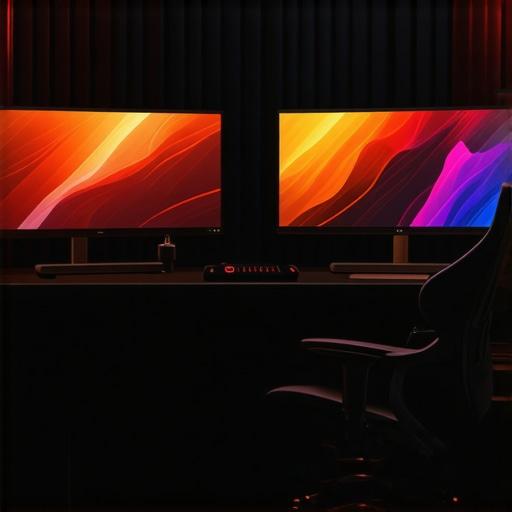
Ever spent hours tweaking your monitor settings, only to be disappointed by dull colors or laggy responses? I’ve been there. I remember the frustration of investing in what I thought was a great display, only to find it lacking when I needed crisp visuals or smooth gameplay. That lightbulb moment hit me hard: not all screens are created equal, and choosing the right monitor can transform your entire experience—whether you’re gaming, working, or creating content.
Why the Right Monitor Changes Everything in 2024
In today’s world, our screens are more than just displays—they’re gateways to immersive worlds or productivity hubs. With advances like IPS technology and 144Hz refresh rates, the gap between good and great monitors has widened. According to a recent report, gamers and professionals alike now prefer high-refresh-rate IPS monitors because they deliver vibrant colors and ultra-smooth motion—without the color distortion common in older TN panels. But here’s the catch: with so many options flooding the market, how do you pick the one that truly fits your needs?
Have You Faced This Dilemma?
Maybe you’ve bought a monitor promising top-notch specs, only to realize later it’s not quite what you expected. Or perhaps you’re overwhelmed by technical jargon, unsure if that $500 screen is worth the investment. Trust me, I’ve made these mistakes early on—buying based on specs alone, ignoring panel quality or real-world performance. It’s easy to get caught up in marketing hype or shiny features, but the right choice hinges on understanding what truly matters for your use case.
Today, I’ll guide you through the essentials of selecting the best IPS & 144Hz monitors for gaming and work in 2024. We’ll cut through the noise, so you can enjoy vivid visuals, silky smooth gameplay, and boosted productivity without second-guessing your purchase. Ready to upgrade your screen and see the difference it makes? Let’s dive into the key factors that will help you make a smart, satisfying choice.
Assess Your Specific Needs Before Diving Into Specs
Start by defining what you primarily use your monitor for—gaming, professional work, or content creation. For example, I once purchased a high-refresh-rate monitor without considering my work needs, only to find it lacked color accuracy. Now, I spend time listing my priorities: vibrant colors for design, fast response for gaming, or a large screen for multitasking. This clarity guides your choices and prevents costly mistakes.
Research Panel Technology and Refresh Rate
Learn the difference between IPS and other panel types. IPS panels excel in color accuracy and wide viewing angles, making them perfect for creative work and immersive gaming. Check out this guide to understand why IPS is a game-changer in 2025. Pair this with a 144Hz refresh rate to ensure smooth motion, especially in fast-paced games. I once upgraded to a 144Hz IPS monitor and immediately noticed the reduction in motion blur, enhancing my gaming performance.
Focus on Response Time and Color Accuracy
Look for monitors with a low response time—ideally 1ms to 4ms—for minimal ghosting in games. Simultaneously, verify color accuracy metrics like sRGB coverage—aim for 99% or higher if you’re into content creation. When I tested a monitor with poor response time, ghosting ruins fast action scenes, so I prioritize this feature. Use reviews and manufacturer specs as initial filters, then verify with real-world testing if possible.
Set Your Budget and Balance Features
Decide your budget early. High-end models with advanced features can cost over $1000, but mid-range options often deliver excellent value. For example, I found a $500 IPS monitor with 144Hz refresh rate and excellent color performance, perfect for my needs. Check out top picks to compare options within your price range. Remember, investing in a good stand and cable management can enhance your overall experience.
Test Monitors in Person When Possible
If you can, visit a local store to see monitors in action. Pay attention to brightness, contrast, and viewing angles. I recommend bringing your own content—photos or videos—to evaluate how the screen performs with what you’ll be using most. This hands-on approach saved me from buying a monitor that looked great in specs but poorly in real life.
Check Compatibility and Connectivity
Ensure your PC or laptop supports the monitor’s inputs—HDMI, DisplayPort, or USB-C—and that your graphics card can handle 144Hz at the desired resolution. I once overlooked this and bought a monitor incompatible with my GPU, resulting in a frustrating return process. Read contact us if you need assistance matching monitors to your setup.
Read Reviews and User Feedback
Before finalizing, browse trusted reviews and user feedback. Pay attention to common complaints or praises related to color consistency, flickering, or build quality. My own experience with a poorly reviewed monitor taught me to prioritize long-term satisfaction over initial impressions.
Make Your Purchase and Fine-Tune Settings
Once you buy, spend time calibrating your monitor. Adjust brightness, contrast, and color profiles to suit your environment. Use calibration tools or software if necessary. Proper calibration can make a significant difference in visual quality, especially for creative tasks.
By following these concrete steps, you’ll ensure your new monitor enhances gaming, work, or creative pursuits, making your investment worthwhile. Remember, the right monitor is an essential tool—choose wisely and enjoy the difference it makes.
Many users believe that selecting a monitor is solely about checking the specs like refresh rate or resolution. However, this oversimplification can lead to costly mistakes and subpar experiences. Let’s dig deeper into what most people get wrong about high-performance monitors and why understanding these nuances can make all the difference in 2024.
Why Most People Overlook Panel Quality and Its Impact
It’s a common misconception that all IPS panels are created equal. In reality, there are significant variations in color accuracy, response times, and viewing angles even within the IPS category. Many buyers assume that an IPS panel guarantees excellent performance across the board, but some cheap or poorly manufactured models can suffer from issues like backlight bleed, washed-out colors, or slow response times. To truly benefit from IPS technology, look beyond the label and check reviews or expert tests. For example, this guide explains how to identify high-quality IPS displays that deliver vibrant colors and fast response times, essential for both creative work and gaming.
Don’t Fall for the Refresh Rate Trap
Another widespread myth is that higher refresh rates automatically mean smoother gameplay for everyone. While 144Hz or higher is generally beneficial, the actual experience depends on your system’s capabilities and the monitor’s response time. Many users buy 240Hz or even 360Hz monitors thinking they will see a dramatic difference, but if their PC can’t output sufficiently high frame rates, the benefits are minimal. Additionally, over-investing in extreme refresh rates can be a waste if the monitor’s response time isn’t optimized. Remember, the goal is to balance refresh rate with low response times and your hardware’s performance. For most gamers, a well-calibrated 144Hz IPS monitor offers a sweet spot of performance and visual quality, as discussed in this article.
Why Do Response Time and Color Accuracy Matter More Than You Think?
Many users focus on the specs they see on the box but overlook how response time and color accuracy truly affect their experience. Slow response times lead to ghosting and motion blur, ruining fast-paced gaming or video editing. Similarly, inaccurate colors can be a nightmare for creative professionals who need precise color reproduction. The key is to look for monitors with response times under 4ms and sRGB coverage of 99% or higher. Calibration is also critical; a monitor with high potential can perform poorly without proper setup. For detailed insights, check this guide.
Have you ever fallen into this trap? Let me know in the comments. Understanding the nuances can help you avoid common pitfalls and truly enjoy the benefits of a high-quality monitor in 2024.
Keeping your monitor in top shape over time requires more than just setting it up and forgetting about it. Regular maintenance, choosing the right tools, and understanding how to troubleshoot issues are key to ensuring your display continues to deliver vibrant visuals and smooth performance. As technology evolves, so do the methods and equipment needed to maintain your monitor effectively, especially with the increasing adoption of IPS and 144Hz displays that demand careful care for optimal lifespan.
How do I maintain my monitor over time?
One of the most effective ways to maintain your monitor is to invest in a high-quality cleaning kit specifically designed for screens. I personally rely on a microfiber cloth combined with a gentle, alcohol-free screen cleaner. This combo prevents scratches and removes dust or smudges that can degrade image quality. For deeper cleaning, I recommend using compressed air to remove dust from vents and around the edges, which helps prevent overheating and mechanical issues.
Another essential practice is to calibrate your monitor periodically. Using calibration tools like the X-Rite i1Display Pro ensures that colors stay accurate, especially if you’re into content creation or photo editing. Regular calibration can also help mitigate issues like color drift, which can happen over months of use. I set a reminder every 3-6 months to recalibrate, ensuring my display remains consistent and reliable.
Tools I recommend for monitor upkeep
Beyond cleaning supplies, software tools play a crucial role in monitoring your display’s health. I use DisplayHDR Analyzer to check for uniformity and backlight bleed, ensuring the panel’s consistency. Additionally, Windows’ built-in calibration tool, along with third-party software like DisplayCAL, helps fine-tune color profiles without needing costly hardware upgrades. These tools provide detailed reports that guide adjustments, saving me from costly repairs or premature replacements.
For hardware diagnostics, I rely on tools like the UPRtek MK350S spectroradiometer, which measures color accuracy and luminance with precision. Although an investment, it’s worth it for professionals who need absolute fidelity. This device can detect subtle issues like panel aging or calibration drift that might not be obvious visually, helping you address problems early on.
What’s the future of monitor maintenance?
Looking ahead, I predict that monitor maintenance will become increasingly automated, with built-in sensors that continuously monitor panel health and alert users to potential issues. Firmware updates will also play a bigger role, optimizing performance and longevity without user intervention. As these trends emerge, staying informed about the latest tools and techniques will be vital for maintaining high-performance displays in 2024 and beyond.
Why not try calibrating your monitor today with a tool like DisplayCAL? It’s a simple step that can dramatically improve your visual accuracy and extend your monitor’s lifespan. Regular upkeep isn’t just about prolonging hardware life; it’s about ensuring your display continues to deliver the crisp, vibrant experience you rely on, whether gaming, working, or creating content. Keep your monitor working at its best, and it will serve you well for years to come.

Choosing the right monitor isn’t just about high numbers and flashy features; it’s about understanding what truly enhances your experience. Over the years, I’ve learned that the most overlooked details can make or break your setup. For instance, I once bought a 144Hz IPS monitor blindly, only to find that poor calibration and panel quality diminished the benefits. The real lesson was: don’t just chase specs—know what quality and performance mean in practice.
The Hardest Lesson I Learned About High-Performance Monitors
One of my biggest mistakes was assuming that a higher refresh rate automatically meant better visuals. I upgraded to a 240Hz monitor, but my hardware couldn’t keep up, and I ended up with micro-stuttering. The truth? Balance is key. A 144Hz IPS display with good response times and proper calibration often outperforms a higher refresh rate monitor that’s poorly optimized. Learning to prioritize response times and color accuracy changed how I shop for monitors.
3 Myths About IPS & 144Hz Monitors That Held Me Back
First, I believed all IPS panels offer perfect color accuracy—this isn’t true. Second, I thought 144Hz was the ultimate for gaming—actually, system performance and response time matter more. Third, I assumed a higher price tag guaranteed better quality, but proven reviews and real-world tests are more reliable. Challenging these myths helped me make smarter, more satisfying choices in 2024.
What Experts Won’t Tell You About Buying Monitors
Many professionals overlook the importance of panel uniformity and calibration tools. I found out that even a high-end monitor can suffer from backlight bleed or color drift without proper maintenance. Investing in calibration tools like the X-Rite i1Display Pro and regularly recalibrating can keep your display performing at its best. This behind-the-scenes knowledge has saved me from early replacements and frustration, making my setup more reliable.
My Essential Toolkit for a Perfect Monitor Setup
Trust me, the right tools make a difference. I rely on a microfiber cloth and alcohol-free cleaner for cleaning, DisplayHDR Analyzer for panel health, and software like DisplayCAL for calibration. For hardware diagnostics, the UPRtek MK350S spectroradiometer offers precise readings. These tools help ensure your monitor remains vibrant and accurate over time, especially with the increasing adoption of IPS and 144Hz tech.
Where to Go from Here
If you’re serious about upgrading, start with comprehensive guides like this resource. Explore reviews, test monitors in person if possible, and calibrate your display regularly. Remember, a well-chosen monitor is an investment that pays off in productivity and enjoyment for years to come. Dive in, stay curious, and enjoy the incredible difference a quality monitor can make in 2024.
Your Turn to Try
Have you ever struggled with choosing the right monitor or maintaining its performance over time? Share your experiences below—your insights might help others navigate their own upgrades with confidence.


![7 Best 144Hz Gaming Monitors Under $300 [2026 Tested Results]](https://monitors.smartscreenshowcase.com/wp-content/uploads/2026/03/7-Best-144Hz-Gaming-Monitors-Under-300-2026-Tested-Results.jpeg)


Leave a Reply